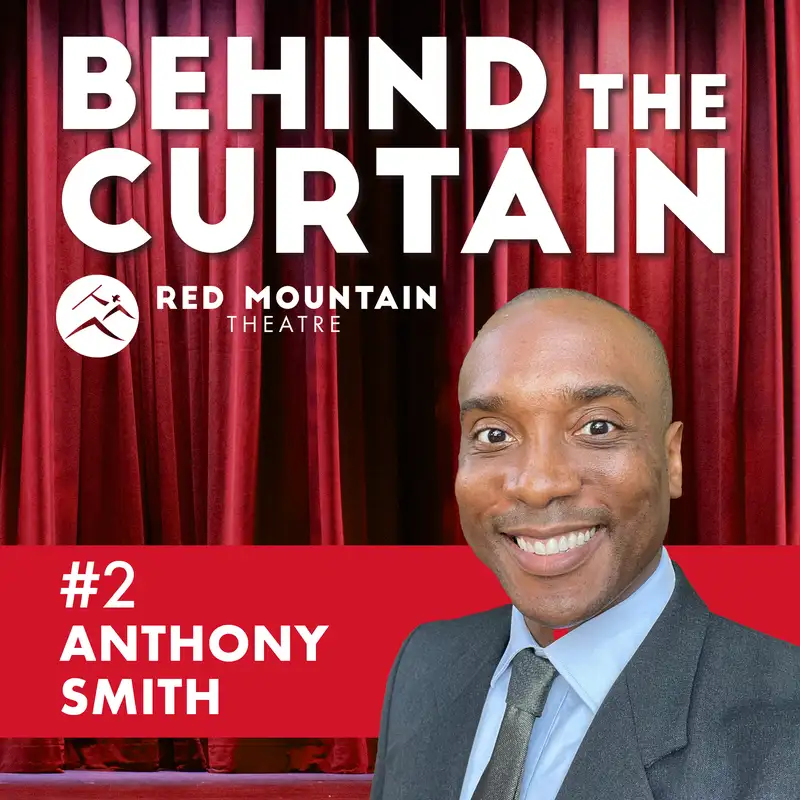
Ep. 2 - Anthony Smith
Download MP3Welcome to Behind the Curtain at RMT. I'm your host, Roy Lightner. This episode, I step behind the curtain with Anthony Smith, the music director of The Wiz. Well, hello, Anthony Smith. Hello.
Roy:Thank you for being here. Of course. So for folks that are listening, you have worked at Red Mountain for quite some time prior to this as the
Anthony:Director of audio visual production was my final title. We, of course, were hired pretty much the same time, and you're a big reason why I took the job in the first place. Excuse me. It was to work with you in our artistic capacity. So I think my initial title was music director in residence, and then it was supervisor of music and sound, and then it expanded to include the lighting department.
Anthony:So I left as director of audio visual production. So it's been it was four years. It was August 2021.
Roy:It was really that long? Yeah. Oh,
Anthony:man. Okay.
Roy:And so I mean, of course, like, we're ecstatic that you're back to music direct The Wiz here. And I'm curious about when I sort of approached you with the idea of music directing The Wiz. You've done it before, but
Anthony:what I've done it a lot. Yeah.
Roy:How many times have you done it?
Anthony:This is number five. No way. I've done it a lot. Yeah.
Roy:So then knowing that, what made you say yes to music directing again?
Anthony:Oh, that's a really that's a really interesting idea. I'm I I'll be very honest. Monet, I think, is a visionary. I think she is just one of the most important voices we have in the theater today. And and while she, of course, is doing everything in her own right, she's kind of, like, on the precipice of, you know, kind of, like, this kind of global stardom as far as Broadway direction and associate direction and everything else she does.
Anthony:And we had we worked together on this she what she's done she did Waitress, she did Color Purple, was it those two?
Roy:That's correct. So this
Anthony:is the third time, so so when when she was doing it, that's great. And I feel the same way about other collaborators, Kim Powers, who actually Kim and I did the last Wiz I did together of Virginia Repertory Theater. She's designed the scenic for that. Love Kim. Love working with John Alexander.
Anthony:And then of course an opportunity to come back and work with kind of all these wonderful people. I mean, you know, all the people that I worked with while I was here, and kind of all those things. So that was kind of the the main pull was like, you know, it's a chance to kind of come back and and see these kind of brilliant artists.
Roy:Well, I'll keep asking for the future. But so I'd love to talk a little bit about, your background. Like, where do you come from? How did you how did a path lead to musical theater and music direction? And you do a lot of electronic music design.
Roy:So would you sort of explain that whole sort of lineage of how you kind of got to the seat? Oh, sure. Yeah.
Anthony:I mean, when I was younger, I knew I was gonna be computer science. That was kind of my thing was I was gonna go to school for computers and I've always played the piano. My mom's a pianist and so I started playing piano when I was two. I've always played, but I didn't think it was gonna be a career. And then I also started playing the flute and was very very good at that.
Anthony:And so then it kind of became like more possible as I got through high school and started having some success Yeah. In competitions that like, oh, this actually might be a path forward. But it was mostly opera and it was classical singing and and as a collaborative pianist. So I was working with opera singers studying languages, working mostly with sopranos and that kind of work to do it. And then honestly, strangely enough, Audra McDonald was really my like kind of turning point, and then there are those kind of sopranos.
Anthony:So Audra McDonald, Dawn Upshaw, Kelly O'Hara, these kind of crossover for lack of a better term artists where I'm like, okay, I really like the singing. It's excellent singing, but I love the immediacy of their connection with English because we are we have the kind of the barrier in opera like, you know, you have super titles or whatever. Right. And so I I love that and then that got me into listening. And then the first musical that I listened to like in full and bought the score to was Sunday in the Park with George.
Anthony:And Sunday kind of changed everything for me. I I didn't know I don't know what I thought musical theater was, but to know that that level of artistry was available and that level of, like, intensity and complexity, musical complexity was available. And so that that was a total kind of game changer to me.
Roy:And when about was that, like, how old were you?
Anthony:I think I was probably I was probably 17 or 18.
Roy:Okay.
Anthony:So where I was like, okay, so that's really interesting. Like, you can do that. And then, of course, I bought all the Sondheim scores, learned those, loved how just difficult. I mean, loved the complexity of them and the, like, deep artistry. I You mean, I was like Right.
Anthony:Oh my god, like these are huge existential questions that we're we're that we're kind of going through here. And so that was kind of my my first like, you know, big like, okay, I think maybe musical theater is a thing. And then in school, I went to school for collaborative piano in Manhattan. What is that? Will you
Roy:describe that? But collaborative
Anthony:piano is like it's like accompanying. Right? Okay. But, like, we call it collaborative piano because it really is much more collaborative than, like, I'm not really just behind. You know, it's like it really should be a collaboration and we're working together.
Roy:So would you describe for people listening what electronic music design is for a musical and, like, how that works. And I know for you, it's, like, very rudimentary. You're smart. Like, it's what you do every day, but it is such a foreign concept to so many different people.
Anthony:Yeah. I mean, I I it's it's so much depends on the title. Right? So, like, you know, talking about The Wiz. The Wiz is really interesting.
Anthony:I mean, we're not doing the most analog version of The Wiz or or the most like non digital version. Although of course when The Wiz was originally on Broadway on the tour, it was totally analog. They had they were one of the first shows to use a synthesizer synthesizers made by Bob Moog. And the last time I did the show, I went like totally analog and did all the sound effects on that like they were done on Broadway. And then like, you know, use like just like very rudimentary like piano, old electric piano, like really kind of dug into it.
Anthony:Yeah. Because I I don't know that was kind of a thing I was on. Now that I'm doing it again, I'm like, okay, we really should kind of, go forward. So for The Wiz, it's it's a much simpler, concept. I think if people think about a show we just did recently like Waitress, electronic music design for Waitress is quite extensive because it's the first thing you hear in the play.
Anthony:You hear the sugar butter flower loop first. Right. So like so that means, you know, for example, I had our brilliant Jenna beta, right, come in and and we recorded all of that material. So we had to record all of the sugars, all the butters, flowers, all the loops for that show because that show again, it's Sara Bareilles.
Roy:Right.
Anthony:It was made her her life is in the studio. And so all those things are things you would do in the studio. So you would do that. So we had to get all that stuff together. And then because I have things that are being played back, I have to have a way to synchronize them with what's happening with our live musicians.
Anthony:And so all of that is done to what's called a click track. And clicks are extremely common in studios. They are also extremely common in film. They're almost necessary in film because you have so many elements to synchronize over such a long amount of time. And in musical theater, we use them a lot.
Anthony:Generally, in musicals, we use them when there are things that like are extremely timing sensitive. In Aladdin, a whole new world because there's a carpet flying around.
Roy:Right.
Anthony:That's automated. In Wicked, it's free the monkeys because there are set pieces moving and there are people in the air and it's like, okay, it would be a safety problem if this was even a touch slower or a touch faster. We really can't have any latitude. Another example is when the wizard sings his reprise at the end of the show because it's a prerecord. So generally, it's like if there's something that has to be prerecorded or something that has to be very tightly synchronized, which brings me to Frozen.
Anthony:So Frozen, is was certainly the biggest electronic music design of my career because we had so much synchronization with the brilliant projections of David Murakami. Right?
Roy:He's coming back for two shows this year, everybody.
Anthony:It's just so exciting. Right? But that that show was I mean, because there were I mean, there were there were so many prerecords. There was so much going on, and then there's also that level of it has to be frame perfect to line up and trigger. And then we also had things being sent that triggered the lighting system and things that triggered sound effects.
Anthony:And so that was a very extensive one.
Roy:Well, and that's a thing that I don't think people know is how much work goes into all of that to make one second that the eye sees and the ear hears happen Yes. And make it happen the exact same way every single show at the exact same time. And, I mean, that's kind of where us as theater artists geek out because that's where we get to do our art and create these sort of moments. Yes. But there's so much work, and an audience will not know if it's working right.
Roy:They will know if it's working wrong.
Anthony:Immediately. Yeah. And it's so and again, so ideally, you know, I I and I generally say, like, as far as a music director goes, I'm like, I I either need the review to say it was the most transcendent experience of my career, my life, or I need not to mention the music at all because ideally if we're in service to the story, all I'm doing is supporting. Like, and yeah, it's gonna sound great, but I, you know, generally when people, oh, it's because something didn't strike their ear properly. So I want it to be seamless, so they're able to fully be in our story, tuned into our actors, and I feel the same way like as a sound all kind of all technical departments too.
Anthony:It's like you wanna just disappear and serve the story.
Roy:So you are functioning as the music director, but then you also will conduct the the pit. How many people are in the pit for The Wiz?
Anthony:That's a really very good question. I should know that off the top my head, but I've done it with a couple of different iterations. I think this one is 12 including me. I think it's 11 plus one.
Roy:I believe that's correct.
Anthony:I was like I think that's right. And and
Roy:like I said, it it this was this is
Anthony:an old show. I it scored for something insane like 28 I think, which I've never done. I think the max I've done it with is 20. You know? And so kind of over the years, I've been able to say, okay, there's a way to make this work.
Anthony:This doesn't make a lot of sense. The Wiz really should be keyword conducted, at least, like, this the the the 74 version.
Roy:And that means what?
Anthony:Oh, so it means the conductor plays the piano and also conducts the show.
Roy:So you're driving the whole ship. You're playing the piano. You're making sure everyone stays together, and your fingers are quite busy. That's right. And that's just a typical Wednesday for you.
Anthony:Well, yeah. I mean, it it also just depends on the title. Right? I mean, some titles, really lend themselves to it and are are written for it. Waitress, again, like, to to the thought of having a stick conductor would be silly.
Anthony:Summer, the thought of having a conductor would be pretty goofy. Frozen, we, you know, we were one of the first people to try this piano conductor version, and that really was like at the absolute kind of limits of what is like possible. Frozen should be sick conducted just because there's so much going on. I liked the challenge of it. I thought we were very successful with it, but there were moments that were like, you know, I I try to not have myself be at like 95 capacity and there were moments where I was at like 98.
Anthony:So like that's that's a little risky for live theater. But like but The Wiz, I mean, because so much of it is they're they're I've been I've, know, talked to the team. I'm like, they're tunes. These are songs. They're beautiful songs, but they're just kind of songs.
Anthony:And so and they're mostly piano driven. So it's like, I could wave my arms around or I could just play it.
Roy:You know? So speaking of The Wiz, what songs or things in The Wiz are you drawn to? Oh, wow. Or are you finding it new in this version? Like, where are you finding yourself aligning with this this play?
Roy:I think
Anthony:I've always loved Soon As I Get Home, Dorothy's first song. I think that's probably one of the finest pieces in the show. I I our cast is doing some really great work that is sort of making me kind of fall in love with some of this music all over again. I think Sean is doing such excellent work. He's the scarecrow.
Anthony:As the scarecrow. Yeah. And then, of course, like, Dorian's doing such excellent work as a tin man. So I mean I mean, I think kind of becau you know, anytime you do it and you kind of see what these actors bring to it, I think that's another thing. And then it's really worth noting, we have a an ensemble member of Temperance who is singing Arrested Body.
Anthony:I mean, and which is which is a very short number, but she just it's it's truly sensational. So, I I would have to say I've said for years, my favorite song really is Dorothy's first song because I think it's a phenomenal I want song.
Roy:Yeah.
Anthony:And then, of course, you know, there's Home. I mean, Home Home is Home is the iconic song of the show for any number of reasons. It's hard. I mean, it's rare that we have our principal woman alone at the end of the show to end the show by herself as a finale.
Roy:And having not left the stage for entire play.
Anthony:For the whole play. So that that's a little bit of a relic, you know, some somebody would some associate director would come in and say, okay. Well, we need to get her off stage and and but back back then, they would do that. But, yeah, I think the one I've been listening to and really kind of I've always loved has been soon as I get home. It's it's really great.
Roy:That's awesome. And it's also nice to root for a character and then have her win. Yes. It is. Is.
Anthony:Not in
Roy:the way that you would think, but like that they that they win.
Anthony:Well, yeah. I mean, and the the whole show really, you know, at the core of it, the one thing I will say about the book, which of course is stolen from, you know, the the the the initial books, but it really is about, like, family Yeah. And love and trust. I mean, these are archetypes, I mean, that show up in pretty much every musical that, of course, I also hope people find allegories for in their own lives. I mean, we start and, you know, Em and Dorothy are kind of not on great terms.
Anthony:And then by the end, there's this understanding and acceptance because of everything we've learned that they're both able to see each other's perspective. And I I think that is the thing that's going to save us in, like, life
Roy:Yeah.
Anthony:Is if we're able to actually see each other's perspectives and hear other voices and examine other opinions.
Roy:And so then what what has been the trickiest part to navigate for this production?
Anthony:Oh, again, here's you know, The Wiz, again, I've done it a lot. I've read it a lot. The movie has some of the most sensational movie music ever written by Quincy Jones, I mean, ever, and it's just like unreal. And again, a huge fan and have seen and played Wicked so much, and I love Wicked. I I I this book and I have had a relationship over the years, I'll say.
Anthony:And by book,
Roy:you mean like the text that they say. Right?
Anthony:The script. The script. And and I know, it it was a different time. It is interesting that, Kenneth Holder, the producer, reached out to William L. Brown, to to to very frankly create a black version of The Wizard of Oz.
Anthony:Yeah. Most notably William L. Brown is white, and so there are questions about how that came to be with the asterisk of this was a different time. And actually, funnily enough, William had done that for several he was contract that was kind of his thing in the industry at the time. And then he ended up writing a musical with Charles Strauss about, like, his life and how, like, he should not have been asked to do these projects, which is was, of course, ran for one performance and everybody hated.
Anthony:So I think anytime I do The Wiz, I I know the music so well, I'm not worried about that. Anytime I do it, I go through and I take a fresh look at the script Yeah. And and and that connective tissue and just say, okay, how can we really maximize this and make sure that every everyone feels good because and and it's, you know, I say most musicals have some degree of difference between score, book, dance. Right? Like something.
Anthony:I personally think like the gold standard of musical theater pieces of shows is Gypsy and I think Gypsy in the initial production pretty much is all three are at 10. That is exceedingly rare. And so I would say like the score to The Wiz is enduring and has some like absolute hits. It's great. There are like actual ballets, several Right.
Anthony:In in The Wiz, and so we have seen some incredible choreography through the years. And then I I would be hard pressed to find someone who would not say that the book to The Wiz is is firmly in third place of the three. So so that that is always my, like, struggle with this particular property is is is some of the text.
Roy:So I've I you have done The Wiz multiple times. Yeah. You're do you're doing it here. You also have so many more exciting things that are heading your direction and stuff that you're doing. I'm curious, Anthony, as an artist, what does Anthony love?
Roy:Like, what if he could what's the dream? What would be the ultimate dream that you're currently pursuing?
Anthony:Yeah. I mean, I think, you know, I think, like, you know, it it sounds kind of insane to say, but like it would be probably conducting a musical in Broadway and like working like from a workshop phase, like through the process with the title. That that's that's I really love that work of like working on new works. I've I've gotten to do that quite a bit in my career and I really really love it. And as far as what I'm attracted to, like it's so it's really as easy as like anything and everything excellent.
Anthony:I mean, I, you know, I just
Roy:What determines excellence for you?
Anthony:For me, you know, it's artistic mastery, which is that I have I have stocked my toolkit, right, as an actor, as a singer, and as a dancer, and so I am able to use my tools to tell the story the way that I want to with freedom. Right? And so if I have that, then then kind of all the barriers go away and you're not stuck. Okay. I guess I can't.
Anthony:I can only sing this note. I can only belt this note because of some kind of technical foundational issue. So I I that that is what I'm drawn to is, like, we're in the room, and we've all done our homework, and we can all do the thing, and so let's see what art we can create.
Roy:Oh, I love that.
Anthony:Yeah. I wanna
Roy:look at
Anthony:some things.
Roy:On top of everything else, you know, music director, composer, conductor, flautist That's right. All of the all of the things. You're also an educator. Yeah. So this industry, you know, everyone has opinions about, so I'm seeking your opinions.
Roy:If someone was listening to this who wanted to go into the world of theater or musical theater, what would be some things that you would tell them at the onset?
Anthony:Oh, wow. I would say that this is an interesting industry. I mean I I can't really think of an artistic industry that is does not have some level of commercialization, but in our industry, like, the the pinnacle of our world, Broadway, is like extremely commercial. There there is no way to pretend that it's not. So much so that it affects the kind of art that we create as an industry.
Anthony:Mhmm. And certainly the kind of art that proliferates throughout our industry. I I I think actually commercialization is is fine. There's lots of money and that money can go to us and that's great. But the thing about commercial is that the trains need to run on time.
Anthony:And so my advice to anyone new is like take the time to build your foundation. Take the time, go acting classes, dance classes, voice lessons, invest in yourself while you have the time to do so. So if you're in high school or middle school or whatever, now is the time. I got the best advice in the world from a virtuoso trumpeter, Rex Richardson. And and Rex said, practice now because when you get out of school, you will not have time to practice.
Anthony:And I and I think about that almost daily because he was so right. So it's like to young kid, it's like, oh, if this is something you wanna do, learn everything you can, master classes, go see shows, Send people emails. But the beginning is the time to invest in yourself because when you get out there, it's not impossible, but it's just so much harder to build that foundation when you're also trying to put food on the table.
Roy:What and the show always ends, but the training stays with you forever. Forever. And it you you carry it to the next thing. Well, thank you. And now I'm gonna do your favorite thing in the whole world.
Roy:We're gonna play some games. Oh, no. So if you'll take your headphones and throw them on.
Anthony:Oh, no. That's why these are here. I was curious.
Roy:So we're gonna start first with a sort of sixty second rapid fire question.
Anthony:Okay.
Roy:Round. Get ready. One second.
Anthony:Alright.
Roy:Your questions will begin the time will begin after the first question.
Anthony:Okay.
Roy:Are you ready?
Anthony:Let's do it. We got one okay. Great.
Roy:Okay. Here we go. What do you do on your day off? Sleep. Coffee or tea?
Roy:Tea. Favorite animal?
Anthony:Dog. Biggest pet peeve? Lateness. Who do you admire most? My parents.
Roy:Favorite superhero? Spider Man. Text or call? Text. What job would you be really bad at?
Roy:Accountant. Biggest dream? Broadway conducting. Favorite TV show? The West Wing.
Roy:Toilet paper over or under? Oh, it's over. Bath or shower? Shower. Chocolate or vanilla?
Roy:Chocolate. Favorite thing about yourself? My talent. Elevator, small talk talk, or awkward silence? Silence.
Roy:Pancakes or waffles? Pancakes. Favorite number? 13. Gold or silver?
Roy:Gold. Ice cream or cake? Ice cream. Action movies or rom coms?
Anthony:Rom coms.
Roy:Morning or night?
Anthony:Night. Sweet or salty? Salty.
Roy:Beach or mountains? Mountain. City or suburb? City. Hoodie or jacket?
Roy:Hoodie. Book or movie?
Anthony:Book. Introvert or extrovert? Introvert.
Roy:Nailed it. Great. Thanks for that. Okay. The next game we're gonna play is we're gonna play a musical name that tune.
Anthony:Oh lord. Alright.
Roy:Queued up. I will say this. Katie Holmes put these together and knew that you were gonna be the guest.
Anthony:Oh, how interesting.
Roy:And so she said they might be a little bit difficult. Those listening at home can play along and see if they beat us, but the goal is we have to name the song. I don't know what they are. Name the song, if we can't the musical, and if we can, the composers.
Anthony:I'm curious because yeah. I mean, especially if she tried to make it hard for me, that's gonna be weird.
Roy:Well, I also think it's gonna look like I'm gonna get fired because you're gonna beat
Anthony:Well, really know. Because she might have she knows me well because she's a a genius, and so she might have found my blouse blind spot. At least she knows what I don't like. It might be stuff from shows that she really likes that I don't.
Roy:So we'll Alright. Are you ready? So as soon as you know, you'll just say. Okay.
Anthony:Don't speak. Don't speak.
Roy:Shrek. Yeah. We did this together.
Anthony:We literally did this show together.
Roy:We did Shrek. This is the donkey song. Don't let me go. Don't let me go. Oh, and and Dorian, who's playing the Tin Man, did that role.
Anthony:Yeah.
Roy:See? Okay. You we like we'll split the points on that one. Alright. We'll do the second one.
Anthony:Oh, for god's sake. It's the beginning of ragtime.
Roy:Rude. Yes. You're right. Bye. I'm like,
Anthony:I have played that solo.
Roy:And by?
Anthony:Oh oh, by, Aronth Flaherty.
Roy:That's Yeah. Call it ragtime. The current production is incredible.
Anthony:It is incredible. Wow. Yeah.
Roy:Alright. Next. Marion the librarian. I love
Anthony:oh god. Of course.
Roy:The Music Man. I wanna do The Music Man. I love that show.
Anthony:The Music Man gets sidebar. Gets gets a bad rap because, of course, West Side Story did not win. Musical Music Man did. But this Meredith Wilson was a genius. The the score of the Music Man is truly sensational.
Roy:It's so good.
Anthony:Yeah. It it's amazing. It's incredible.
Roy:Yeah. Dun dun dun dun.
Anthony:He's so good.
Roy:Dun dun. Yeah. Okay. That's Mary and the librarian. Right?
Anthony:Yes. It's Mary Poppins. It's a step in time dance program.
Roy:That's not fair. You can't you did that. I've done the show so much. I mean, we did it together, Yeah. But, like
Anthony:But, like, that's that's a That's not fair. Lick.
Roy:Yeah. Katie okay. Mary Poppins is
Anthony:the seventh time dance break.
Roy:Yeah. Alright.
Anthony:Oh, I mean, hello. It's a tornado from The Lizz. Hilarious.
Roy:Also not there, Katie.
Anthony:Okay. Right now.
Roy:It's a tornado from The Wiz. Well, great. So we've done two of the shows together. You're doing one right now. Right now.
Roy:And we will do the other two together.
Anthony:We really should.
Roy:We will make that happen. I Well Is that it? That's it. Thank you so much.
Anthony:Oh, he's wait. He said I think he says there's Okay. One
Roy:Oh, I thought there were five. Okay.
Anthony:Here we go. Oh my god. Hilarious. It's wonderful from Wicked. Very sweet.
Anthony:I appreciate that. Katie is gonna be fired.
Roy:No. You're not. You're not. Wonderful from WikiA
Anthony:because Anthony plays them. Shorts?
Roy:Okay. Great. Well, I've never played Wicked. Great. This is thanks, Katie.
Roy:Anthony, thank you for being here.
Anthony:Thank you. It's been
Roy:a blast chatting with you, and we really appreciate you.
Anthony:This was fun. Yeah. Awesome. Thanks. Thanks.
Creators and Guests